
Content Tagged “neareast”
-
Netanyahu claims “the Arab Parties” Stole the Election
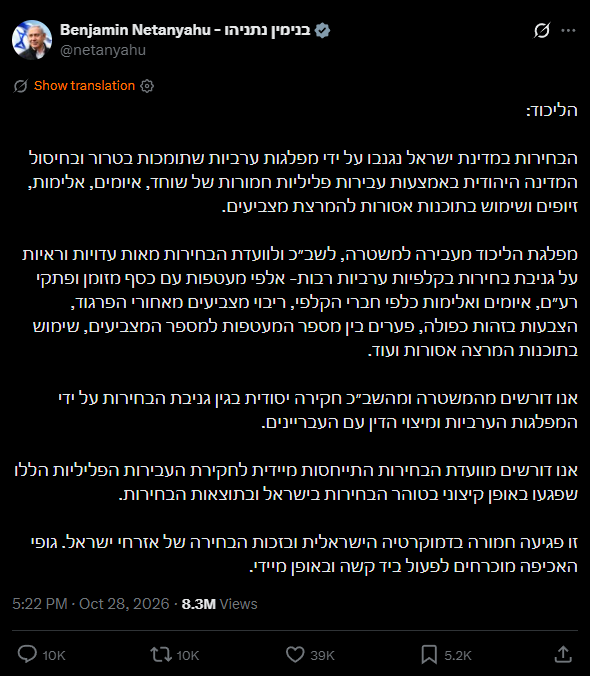
This is remarkable. Benjamin Netanyahu on Twitter:
Likud: The elections in the State of Israel were stolen by Arab parties that support terrorism and the elimination of the Jewish state through serious criminal offenses of bribery, threats, violence, forgeries, and the use of prohibited software to mobilize voters.
The Likud party is transferring to the police, the Shin Bet, and the Central Elections Committee hundreds of testimonies and pieces of evidence regarding election theft in many Arab polling stations — thousands of envelopes with cash and Ra’am slips, threats and violence against polling station members, multiple voting behind the curtain, voting with double identities, discrepancies between the number of envelopes and the number of voters, the use of prohibited mobilization software, and more.
We demand from the police and the Shin Bet a thorough investigation into the election theft by the Arab parties and the full prosecution of the criminals. We demand from the Central Elections Committee an immediate response to investigate these criminal offenses that have severely damaged the integrity of the elections in Israel and the election results. This is a serious blow to Israeli democracy and the voting rights of Israeli citizens. The law enforcement agencies must act with an iron fist and in an immediate manner.
-
US / Iran Peace Negotiations Are Progressing
Some good news for a change:
The U.S. and Iran made progress during talks in Switzerland on Monday toward reaching a final deal within 60 days, including the agreement to establish a committee and a mechanism to end hostilities in Lebanon.
“The Lake Lucerne Summit was conducted in a positive and constructive atmosphere. Encouraging progress has been made, including the creation of a mechanism for further technical talks,” according to a joint statement by mediating parties Qatar and Pakistan.
Building on a memorandum of understanding signed last week, the parties agreed to establish a “High Level Committee” that will provide political oversight of the mediation. Chief negotiators will report regularly to the committee and lead working groups on nuclear, sanctions, and dispute resolution, according to the joint statement.
The parties also agreed to establish a “de-confliction” cell between the U.S., Iran and Lebanon, facilitated by the mediating countries, to ensure full termination of military hostilities in Lebanon.
→ U.S., Iran agree on roadmap for final deal and plan to end military operations in Lebanon, CNBC
-
Palantir and the US Strike on the Iranian Girls School
This is the best analysis I’ve seen of the US military strike that killed over a hundred young girls in a school in southern Iran.
By the time the war began, “AI safety” and “alignment” and “hallucination” and “stochastic parrots” had become the terms of every argument about artificial intelligence, structuring and limiting what we could even say. Worse, “artificial intelligence” itself had come to be synonymous with LLMs. When the school was bombed, those were the terms people reached for, despite the fact that this critical apparatus offered a poor fit for the older, more mature stack of technologies involved in targeting. The real question, the question almost nobody was asking, is not about Claude or any language model. It is a bureaucratic question about what happened to the kill chain, and the answer is Palantir.
→ The Guardian: AI got the blame for the Iran school bombing. The truth is far more worrying
-
Israel’s AI Howitzer
War is horrible. The only thing that seems more horrible than war, to me, is war that isn’t even waged by humans, but by computers.
Israel’s military has taken a step toward a more automated battlefield, deploying a new artillery system that uses artificial intelligence to compress the time between identifying a target and opening fire. The system, known as the Ro’em, was deployed by the IDF’s 282nd Artillery Regiment during operations in southern Lebanon, where it was used to strike Hezbollah rocket and anti-tank launch sites in support of ground forces.
Where its predecessor, the US-made Doher, relied on manual processes and large crews, the new system operates with a level of automation that brings it closer to a semi-autonomous battlefield machine. At the center of that transformation is artificial intelligence. Unlike traditional artillery, where targeting, loading and firing are largely manual, the Ro’em compresses these steps into a largely automated sequence. Once a target is designated by an operator or commander, the system can independently load ammunition, calculate firing solutions, aim and fire with minimal human intervention. It is also integrated into broader military command-and-control networks, allowing it to receive targets directly from intelligence systems or operational headquarters.
→ CTech: Israel’s new AI-powered artillery makes combat debut in Lebanon
What could possibly go wrong?
-
Bret Weinstein & Tucker Carlson on Iran
We’ve all been told a lot of things about both Bret Weinstein and Tucker Carlson. And while I don’t agree with either of these two on a lot of topics, they are both formidable thinkers and very good speakers. I challenge you to file away your preconceived notions — that you probably got from media commentators — for two hours and just listen to this conversation. I found it very engaging and also educational:
→ Unholy War: A Conversation with Tucker Carlson on DarkHorse