
Starfleet Academy is a Disgrace
 Holly Hunter plays what passes for the captain in “Starfleet Academy”, the latest Star Trek series (Paramount)
I don’t watch Starfleet Academy. Don’t get me wrong, I love Star Trek and I’ve watched at least one episode of TOS, TNG, DS9, VOY or ENT pretty much every single week for decades, but everything after Enterprise, especially the stuff produced by Alex Kurtzman, is just slop. And it’s getting worse. So much worse, that I decided, when Starfleet Academy premiered a few months ago, that to save my sanity, I would not watch any of it. I’ve seen a lot of YouTube reviews of the various episodes, though, and as it turns out, my decision was the right one. This show is horrendous.
I watch Star Trek because I like to watch competent people solve difficult and morally ambiguous problems in intelligent ways. The new shows have none of that. Kurtzman Trek has replaced this with a bunch of DEI hires running around headlessly screaming (literally), while lots of stuff around them blows up. Based on clips I’ve seen from this latest show, several of the actors — including Holly Hunter, who plays the captain — can’t even enunciate words properly. I haven’t needed subtitles to understand English speaking actors in a show since the year 2000, but this actually got me there.
There have been more problems with the morals portraited in these shows and their understanding of the lore and technology of Star Trek than I can count. As far as ethics are concerned, Alex Kurtzman and his friends, on the most basic level, do not understand how science fiction works. As showcased by the man’s recent Saturn Award acceptance speech, he thinks science fiction is there to push a message on viewers. What he simply doesn’t understand is that, while it’s true that Roddenberry-style science fiction is indeed about examining the present through the lens of a fictional future, the idea is specifically not to propagandise people, like he thinks it is. Sure, Star Trek has also done that in the past, but those always ended up being the most ham-fisted and generally worst-received episodes. What Star Trek is good at is presenting the viewer with a moral dilemma that has two valid answers (or, in some cases none, actually) and then having the characters navigate that, in order for the viewer to decide how he or she feels about this. That’s how this sort of science fiction works, if it is done well. Kutzman obviously cannot comprehend this.
As if this wasn’t bad enough, his shows fail on much shallower level, too. A level that, from a cursory view might be quite unimportant, but which — together with the aforementioned ethical values — have made Star Trek what it is today. Or was, before Kurtzman got his hands on it. This other feature of Star Trek is actually quite simple: narrative consistency when it comes to the franchise’s universe and its technology. The Next Generation Technical Manual, a book I have owned since the mid-1990s, exemplifies this ethos. It is actually based on the production bible that was used during the shooting of The Next Generation. A production bible is a document put together by producers and technical consultants, that artists and writers on the show are required to read and abide by. It explains, for example, how the warp drive works and what you can, and most crucially can’t, do with a transporter.
Kurtzman Trek doesn’t have anything like a production bible — and it shows. Technology does one thing one week and then does something completely contradictory the next. In a show like TNG, which is episodic and resets pretty much to the status quo every week, that wouldn’t actually be as noticeable as in something like Starfleet Academy or Discovery which is heavily serialised and where several episodes, or even a partial season, are meant to be binge-watched in one setting. So you’d think it would be even more important to be consistent in a modern show. You’d think … In reality, shows from the ’80s and ’90s did this stuff much better than this modern slop.
I actually stopped watching modern Star Trek during an episode of Discovery where the incompetency of these shows and their inconsistency about their universe and technology came to a head for me. The dialogue was already abysmal and I only kept watching the show because, at the time, I was paid to write reviews of it for heise online. I then saw this scene where some characters leave a turbolift and step into a space outside it that was bigger than the ship they were in. This was like watching an action movie where a character gets stuck in an elevator in a skyscraper and he exits the elevator through a hatch in the top only to find himself in an elevator shaft the size of Central Park. Since the characters weren’t drugged and the episode obviously wasn’t transitioning into an absurdist dream sequence à la The Big Lebowski, I could only assume this was supposed to be serious. At that point, not only was my suspension of disbelief shattered forever, as far as this series was concerned, but I also started to seriously doubt the intelligence of anyone involved in creating this show.
Watching the reviews of Starfleet Academy has ended these doubts permanently. This is a show produced by stupid people. And if you think this is good entertainment, you seriously need your head examined. What follows is just one example of one plot point from the final two episodes of the first season of that show.
Mines, All Around Federation Space!
They take one of the coolest Voyager episodes ever and completely shit on it. The most dangerous substance in Star Trek history has been stolen by an idiot commanding six ships and can now apparently be replicated at will. It also doesn’t destroy the universe anymore, it’s just a pretty bad explosive now. But that isn’t the stupid part of the episode. Granted, all of that is stupid and repeats a very common mistake in Star Trek where you take an awesomely dangerous thing and slowly make it cute — which famously happened to the Borg over several TNG seasons — but it gets much worse.
The evil guy in this show now uses this substance to create mines and, get this, places them all around Federation space. Yes. They actually say this. Well, they keep talking about it as a “wall” or a circle when it actually would be more like a bubble, but let’s not get into that. This is stupid enough as it is. It’s actually quite hard to convey to someone who only casually watches some Star Trek once in a while quite how monumentally stupid this is.
We might start with the classic quote by Douglas Adams from the start of The Hitchhiker’s Guide to the Galaxy:
Space is big. You just won’t believe how vastly, hugely, mind-bogglingly big it is. I mean, you may think it’s a long way down the road to the chemist’s, but that’s just peanuts to space.
Of course, the people writing Star Trek episodes these days have never read The Hitchhiker’s Guide. They don’t read science fiction. So they have no idea that space is bigger than their very limited imagination. They also don’t do any research. Granted, the actual size of the United Federation of Planets has been debated for as long as Star Trek exists, but even the minimalist position in that argument would suggest it’s about 100 light years across. Which at warp 9.8 (something that is sustainable for a starship only when we get to the VOY era) would still take more than three months to circumnavigate.
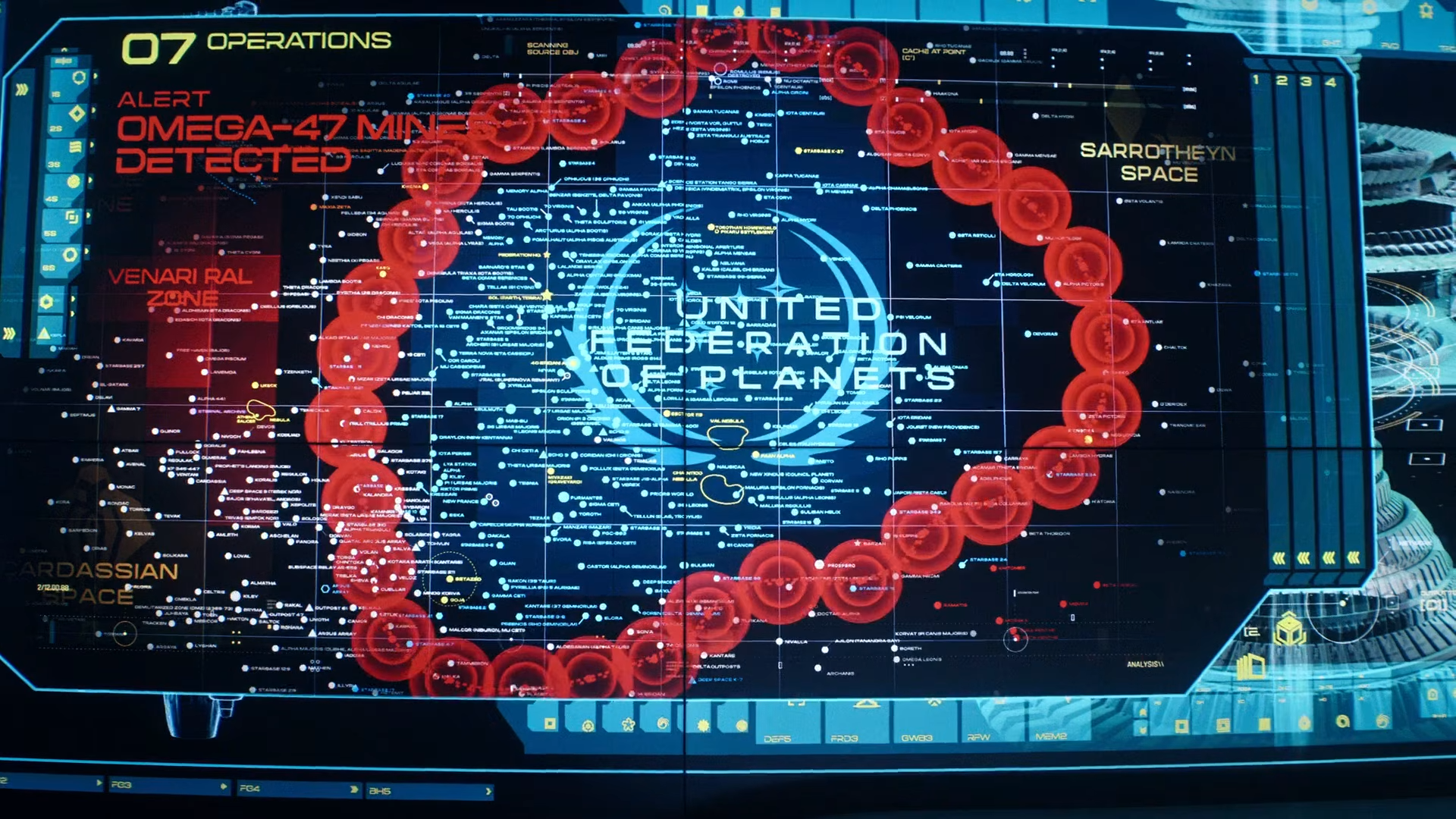 A screenshot from “Starfleet Academy” meant to visualise the idiotic concept of mines placed all around Federation territory (Paramount)
More realistically, the Federation is actually closer to 10,000 light years across. In the Starfleet Academy season 1 finale, they actually say the minefield is “80,000 cubic light years” big. Now, let’s remember Voyager, which they directly reference several times in this show: The U.S.S. Voyager, the fastest ships in the Federation at the time, had to travel 70,000 ly to get back home, which they estimated would take 75 years of all-out flying at high warp.
Are you starting to grasp the scale here? To mine around all of Federation space in three dimensions — because the Federation is actually a bunch of planets located in three-dimensional space, unlike what the writing and the visuals in Starfleet Academy suggest — would take decades. Even with the impossibly advanced technology they have in that show. Simply because physics has its limits and the logistics of the plan create problems whose solutions don’t scale — even with infinite amounts of energy and other resources.
To mine such a vast area with a mine positioned every few light years would require billions of mines. How is the villain guy supposed to have accomplish this in months? Even if you could simply replicate these mines at will — discounting the monumental energy cost and the fact that they are made with an incredibly rare substance — you’d have to replicate hundreds of thousands of mines per second to create that many in a few months. And that doesn’t even answer the question of how you’d fly all around a bubble tens of thousands of light years in diameter in months.
This is just stupid. It’s obviously written by people who use words they think sound smart, but which they don’t understand. In another scene, one of the mentally challenged characters in the show actually says there are “hundreds of mines”. Sorry what? To mine all around Federation space? Who is this show made for? When I was around fourteen, reading books that explained astrophysics to teenagers and watching TNG, I would have picked up on how stupid this is! The people making this show are grown-ups! This is insultingly dumb television.
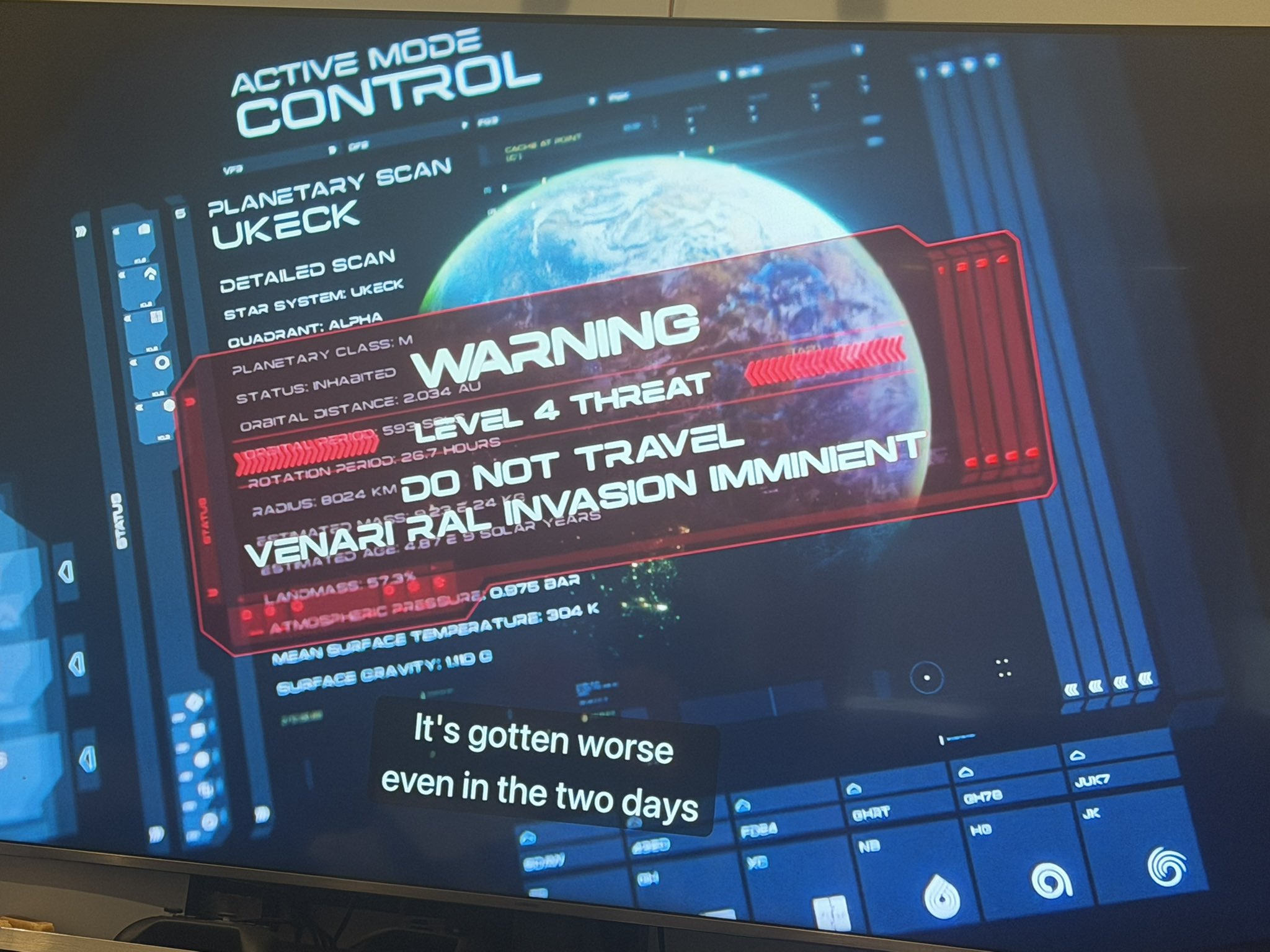 Starfleet Academy producers trying to spell the word “imminent” (Paramount / Screenshot by Alan Ng)
It wouldn’t be so bad if this wasn’t Star Trek. But Star Trek is supposed to be TV for smart people. Apparently, that ship has sailed. Hollywood has totally given up on catering to smart people. They might as well have AI write the scripts now. It can’t possibly get more illogical and inconsistent than this shite.
Now, at this point, people usually come at me saying things like “who cares?”, “it’s just a TV show” and “things change, go with the times!” But what these people fail to understand is the value of Star Trek. Without smart dialogue, competent characters, morally ambiguous problems to solve and consistency that produces a believable world for all of this to take place in, you literally don’t have Star Trek. That is what Star Trek is! If you take all of that out, like Kurtzman has done, all you end up with is just another show. Why would you want to produce that? If I wanted to see incompetent, emotionally broken characters spout dumb lines at each other while things explode around them and I wouldn’t care about the world they inhabit to make sense, I would just watch any show on Netflix. Why would you want to kill all of the stuff that made a franchise successful for 50 years just to spent $10 million an episode on a show that’s indistinguishable from any other show out there? What’s the plan here?
Creating an internally consistent universe was what grounded Star Trek episodes and made them so good. It is a formula that has been developed, by trial and error, over multiple shows and several decades and was emulated by many other writers and producers. Because it works. And it was successful. What does Kurtzman have to offer to replace it? Dumb storylines and a pacifist, gay Klingon in a skirt? Really? If you believe some performative gestures, flashy visuals and getting a propaganda message shoved down your throat is preferrable to smart storylines and actual ethical standards, I have no idea why you were watching Star Trek in the first place.
These people are not doing this because it’s a better model for a TV show. They are doing this because they are incapable to measure up to what came before. Sadly, some corporate slop department put them in charge anyway. Just have mercy with us and let Star Trek die, already!