
Response to Stuart from NoAiList.org
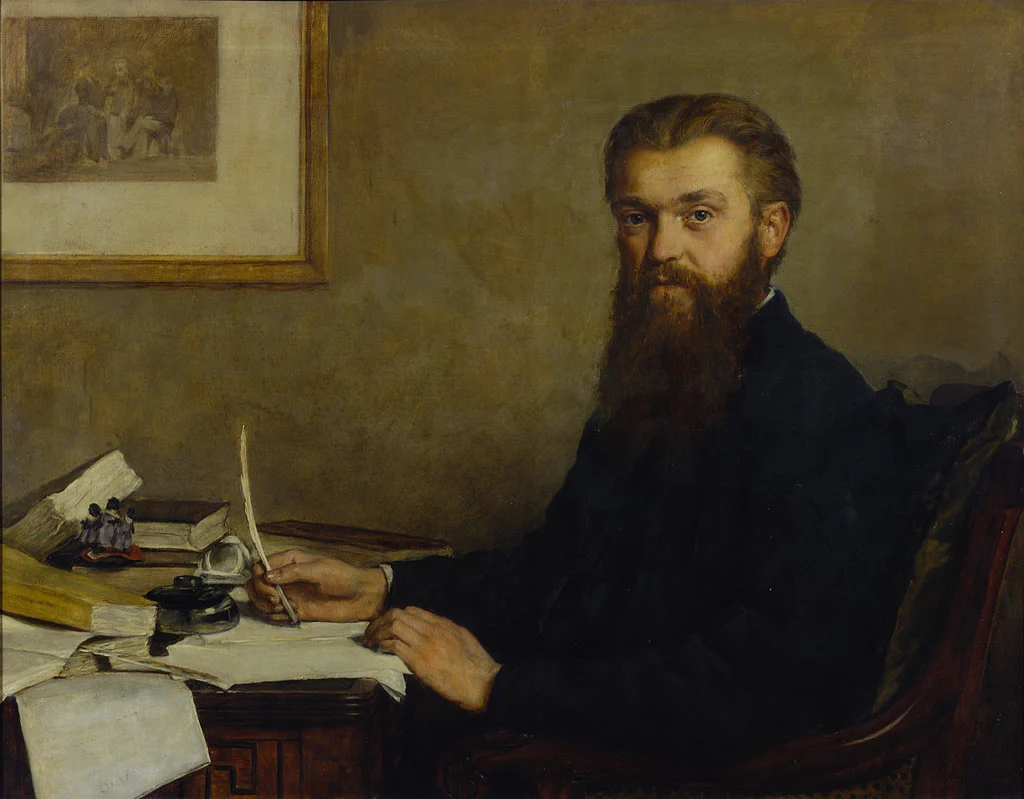 Portrait of William Kingdon Clifford by John Collier (1878)
Dear Stuart,
this looks like an interesting project! I am happy to be added to the list, but I do have some comments:
I am not against AI for ethical or moral reasons. At least not in principle. I feel it is much to early to decide if the technology, as it stands, is good or bad. And anyway, technology rarely is purely on one side of what is almost always a spectrum. The nuclear bomb might be the rare exception to the rule here.
I do have moral qualms about the effects of AI, however. And I pointed some of the details of this out in my editorial on this topic. But my misgivings are mostly about how what we call AI is used right now and much of this could be changed by the companies building these systems. Therefore, I am not sure that I will be against AI forever. If the companies that produce this technology change it for the better, I might be okay with it in the future. I think that is highly unlikely, taking into account how Silicon Valley companies have operated historically, but it could happen.
My issues with AI are not of ideological nature. My problem with this technology is that it doesn’t do what its creators promise. It starts with the name — this stuff clearly isn’t intelligent at all — and ends with the actual results you are getting from it when compared to the work produced to a competent human being. It’s crud, to be frank. And in my now rather long career as a tech enthusiast and later journalist I’ve heard the same old “just give it time, the next version will be awesome” excuse from the Silicon Valley tech bros too many times to believe any of that any more. I believe it when I see it and when that happens, I’ll call it like it is. But right now, I’m not seeing it. What I am seeing is hype and cheap parlour tricks around some basic mass-data analysis with statistical algorithms that we should have had twenty years ago, to be honest. And I see many people, many of them quite tech-savvy people that use this stuff every day, being made a fool of.
Now, some comments on some of your thoughts. I have read a bit of the stuff you have written on the project website and on some Mastodon instances and while you have raised some good points against AI and provided some very useful links on the project’s website, some of this comes across as a bit too morally judgemental for me. I try to live my life by the simple maxim of trying to tolerate viewpoints and cultures I don’t agree with as long as the people involved are not trying to tell me how I should live. I guess you could call that “live and let live” or the Golden Rule, but it also means that I don’t like it when people get too preachy about things. Do your thing, but also accept when other people don’t agree with your thing. This extends to my stance on AI and I learned this from years, maybe decades, of trying to convince people to use Linux, which my older self looks back at with some regret, because I simply didn’t understand how people make decisions and that a lot of my efforts were wasted because I had the wrong approach. I fear that being judgemental towards people who use AI these days would be falling into the same trap.
I would also be careful to use terms that have serious implications too flippantly. Two examples from your project site are “theft” / “stealing” and “CSAM”. I see myself as part of a group of internet nerds who have fought for decades to tell people that copying digital information isn’t theft. We had to fight that battle when the MPAA and RIAA tried to claim that copying some bits was stealing and we’re still fighting this battle when it comes to stupid “hacking” laws that criminalise the mere act of copying data or blatant misunderstandings of copyright when it comes to software development. So when you say that AI is “stealing” text or art or information, that is not very much based in reality. It is the same stupid generalisation that lawmakers and lawyers alike use who have no idea about the actual technology involved. It doesn’t mean that training LLMs on publicly available material on the internet isn’t bad or immoral — I think it is — but it isn’t theft. And calling it that muddles the actual issue and weakens your argument.
I feel similarly about using the CSAM hammer to argue against AI use. That’s what lobbyist and corrupt politicians have done for years to push through draconian laws and take away people’s freedom of speech, privacy and liberty. I simply don’t think we need to stoop to this level. We have better arguments. Arguments that are intellectually sound. Technical ones.
Besides, when you point to Grok creating CSAM material, what you are saying is simply wrong. I don’t doubt that generative AI can create images that look like child abuse material, but in a technical — and more importantly a legal — sense, it isn’t. I am obviously not a lawyer or in the business of giving legal advice, but the whole selling point — and a large part of the evil — of AI is precisely the idea that the stuff it generates can’t be linked (in a legal sense) to the training material. If that wasn’t the case, every copyright holder could sue these companies and they would be long gone. The same goes for criminal proceedings, I would think. If these companies could be prosecuted for illegal source material in their training data without definitive proof it exists in the first place, many people working at these companies would be in jail by now. Don’t get me wrong, it’s good that this isn’t happening. If this would be an accepted interpretation of the law, our legal systems would be the most dystopian nightmare you can imagine.
Anyway, I doubt very much that these systems were trained on actual CSAM material. Maybe read into some actual court cases and the associated investigations of stuff like this … you will see very quickly how easy that stuff get’s found if it ever reaches public cloud infrastructure and how thoroughly it is investigated. If Grok was trained on actual CSAM material, there is no way I can imagine this wouldn’t result in criminal proceedings. It is impossible to keep large amounts of data this sensitive in-house. And why would you do that in the first place? This seems extremely implausible to me. Now, the problem that lawyers and judges are using chatbots and that the bad information these systems provide is breaking our legal systems, is a real one. And so is the horror of AI-powered wars.
I hope you take these comments in the spirit in which they were offered: I generally like the idea of your project and want to help you improve its effectiveness. Please let me know what you think about my thoughts — or feel free to completely ignore them.
Best wishes from the Rhine!
--
Fabian A. Scherschel
Freelance Journalist
fab.industries