
The Jeffrey Epstein Autopsy
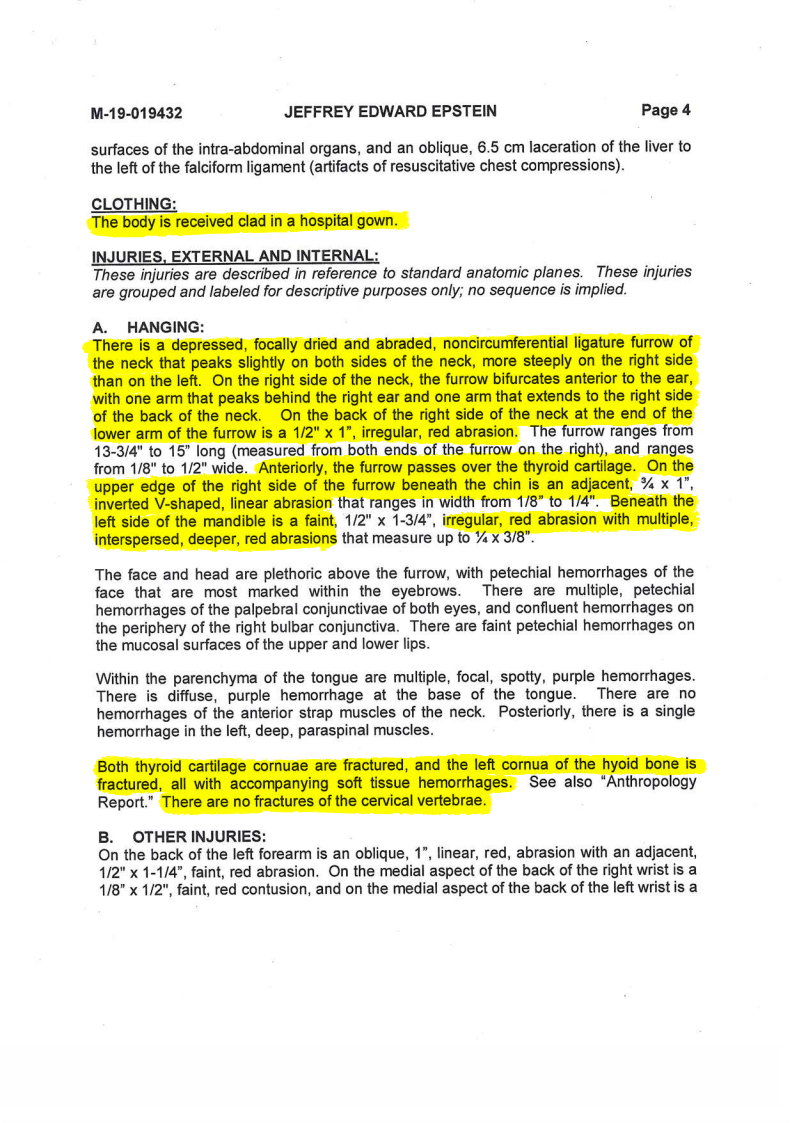
I’ve been looking through the documents and photos from the Jeffrey Epstein autopsy all morning. The New York Times broke the story last night:
Michael Freeman says he had one thought when he first saw a photo from Jeffrey Epstein’s autopsy: “Wait a minute, that doesn’t look like a hanging mark.” The noose had not left a smooth, consistent line on Mr. Epstein’s neck that slanted to a peak, as in a textbook hanging. Instead, the mark was deep, ragged and branched into a Y-shape on one side. Dr. Freeman, a forensic scientist who studies bias and error in death investigations, spent a year examining Mr. Epstein’s autopsy file, which was given to him by the dead man’s brother. He is seeking to publish his findings in a peer-reviewed journal, but has been rejected so far. On Monday he presented them at the Middle Temple, a London legal society, where he argued that Mr. Epstein’s injuries are most plausibly explained by homicidal strangulation. He also asserted that injuries on the body suggest there was a struggle, contrary to the medical examiner’s findings. “The pattern and distribution and multitude of injuries are not explained by a suicidal hanging,” he said.
The totality of the circumstances surrounding Jeffrey Epstein’s death in a federal detention center in 2019 points overwhelmingly to suicide, and several investigations have failed to produce evidence that anyone other than Mr. Epstein had a hand in it. Dr. Freeman’s analysis, parts of which he floated in a New York Times investigation earlier this year, may rekindle long-smoldering debates about his death. Forensic pathologists who have seen some of the autopsy photos, though not the entire set, have agreed that the mark on Mr. Epstein’s neck was atypical for a hanging. Some of those experts said the images could still be consistent with suicide, but they cautioned that the injuries alone could not tell the full story, and that a cascade of institutional failures would make it difficult to ever conclusively determine what happened. The New York City medical examiner’s office, which performed the autopsy, said this week that it “stands by its determination” of suicide.
Much information that medical examiners would normally use to determine a cause of death was unavailable; the examiner was not permitted to inspect the cell, for example. That has left the autopsy photographs as some of the only concrete evidence. After being asked by a journalist to look at the hanging mark, Dr. Freeman asked Jeffrey Epstein’s brother, Mark, whether he could see the complete file. As next of kin, Mark Epstein was one of the few people who had access to the autopsy. He shared the file with Dr. Freeman last November.
Now, I am obviously far from an expert here. But as an aspiring crime novelist I am interested in the details of these investigations. And I was actually at a popular science lecture about forensic pathology this Sunday, which as chance will have it, was focusing on delineating suicides from homicides. Now, I haven’t seen enough strangulation and hanging marks to comment on if it is likely that he hanged himself, as the autopsy report claims. The marks above the ligature, that Dr. Freeman claims are finger marks in this BBC interview1, do look strange, though.
But what I can tell you, however, not least from the lecture on Sunday, is that it seems highly unusual and suspect that neither the police nor the medical examiner had access to the possible crime scene. It would seem to me that finding the actual material that caused the ligature mark around Epstein’s neck and discerning how he might have hanged himself in that cell would be paramount. From my limited knowledge, the lividity marks on his body seem to indicate that he spent the most time after his death on his back, not in the sitting position that he was supposedly found in. So there are clear questions about ruling this a suicide from that alone.
It also strikes me as really weird that they would intubate and completely undress a body that had been dead for hours — and then even move it to a hospital! Any EMT on day one of their job should have been able to tell that Epstein was long dead. It seems to me the EMTs should have recognised he was dead, left the body at the crime scene and called the police, as with so high-profile a prisoner, at least suspecting foul play at that point should be common sense.
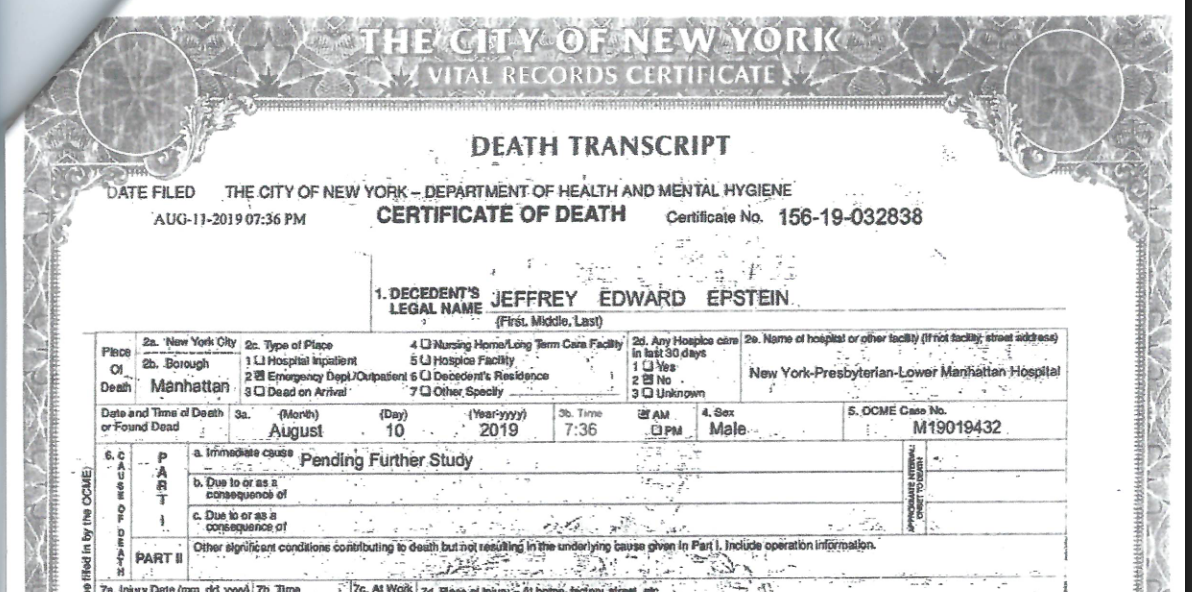
Based on the lack of evidence, it seems to be impossible to decide conclusively whether this was a suicide of whether Epstein was murdered — possibly by another inmate as his brother seems to suggest. But it is important to state that this lack of evidence came about because everyone, including the medical examiner in charge, seems to have quickly decided that this was a suicide. Changing the initial death certificate (see image above) from “pending further study” to “suicide”, precluded further study and destroyed the ability to collect evidence that might suggest this was in fact a homicide. And the cause of death was, of course, changed before anything further could have been studied.
The City of New York officials seem to have done in this case what in Sunday’s lecture two forensic pathologists from the University of Düsseldorf and a senior criminal investigator from the city’s homicide squad told us you should never, ever do: go into a scene with a conclusion in mind. In these investigations, it is of paramount importance to collect as much evidence as possible as early as possible and to keep an open mind about that evidence, including the evidence collected in the autopsy. This was simply not done in Epstein’s case, it seems.
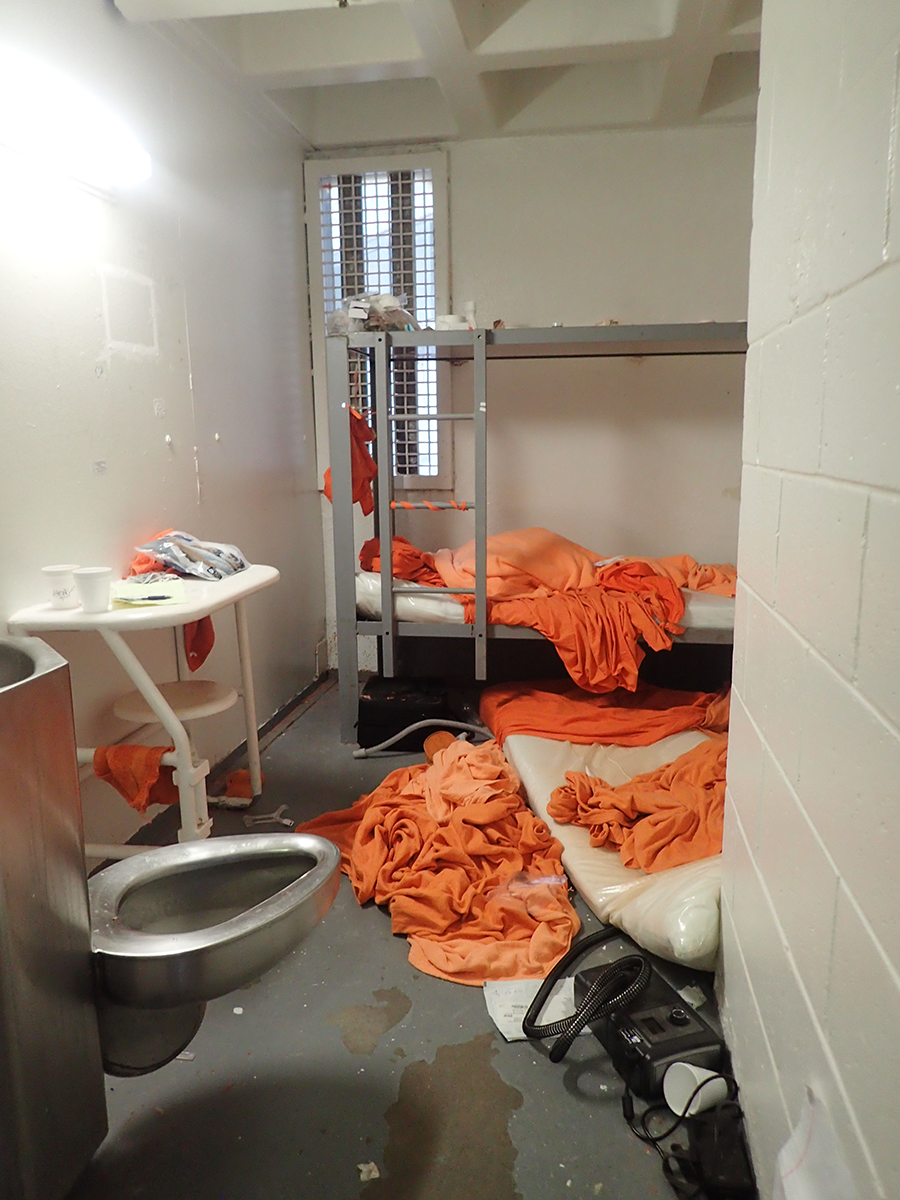 The investigation package includes 23 photos of Epstein’s cell such as this one. These photos were clearly not taken by a professional criminal investigator. Evidence is not marked and it is not clear at all what parts of the scene were disturbed before these photos were taken.
If you want to look at the evidence we do have — courtesy of Epstein’s brother and last remaining relative, Mark Epstein — you can download the autopsy photos and official document package here. But please be aware that this includes very graphic images of a dead person and of the cut-open body and various organs.
Overviews of all the other strange circumstances in this death can be found in this article and this one, among others. Jeffrey Epstein’s brother recounted his view of what he thinks is the murder of his brother in this interview with Tucker Carlson in 2024.