
Books I’ve Read in 2026, Part 1: “Surface Detail” by Ian M. Banks
This article is part of a series on the books I’ve read this year:
- Part 1: Surface Detail by Ian M. Banks

The first book I finished in 2026 was one I had begun, and read most of, in the previous year: Ian M. Banks’ Surface Detail. This book is the ninth out of ten novels in Banks’ Culture series.
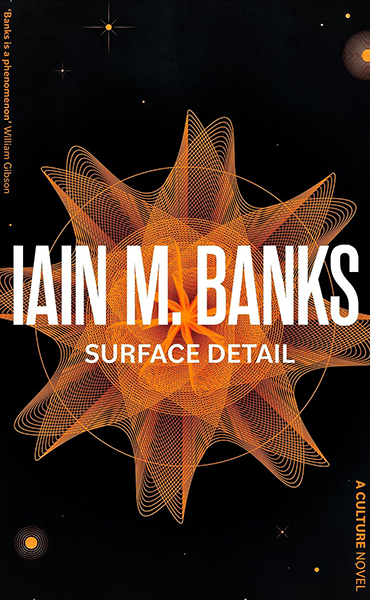
Surface Detail by Ian M. Banks
Published: 2010
Genre: Science Fiction
Length: 640 Pages
I started reading the Culture series a couple of years ago in my quest to catch up with some science fiction classics that, so far, I had not gotten around to read. Due to the peculiar nature of this series, mostly to do with its setting, I had to put it down several times to read something else, because the series was getting on my nerves. That’s why it has taken me a while to get through all of the books.
The Culture Setting
Don’t get me wrong, these books are great and pretty inventive. They are probably the best depiction of what humans living together with artificial intelligence — actual artificial intelligence, not the primitive statistic algorithms we are using the term for at the moment — would look like.
But since human civilisation in these books — also known as “The Culture” — is so amazingly advanced, the stakes are not immediately recognisable to readers. For example: Humans basically can’t die in the Culture, they can change their sex (i.e. their reproductive organs, not merely their gender) at will and weapons are so advanced that they are basically not recognisable as such.
When you begin reading this series, all of this is new and fascinating and amazing. But it is also very hard to connect with on an emotional level. The funny ship names are great and there is a kind of novelty about it all. But two or three books in, I got a bit fatigued of it all. Banks is great at finding new ways of making the setting interesting, and giving readers ways to connect to the experiences of the characters, most of the time, however. So I did return to the series again and again. Surface Detail is probably his best attempt at this out of the nine books I have read. It uses the setting to excellent effect.
The Novel’s Plot
Without entering into too much spoiler territory here, the book follows the quest of young woman Lededje Y’breq to kill a powerful man named Veppers, who has held her as his personal sex slave since she was a small child, and who subsequently kills Lededje. But unbeknownst to both of them, a Culture warship by the name of Me, I’m Counting had implanted her with a device that allows her to be reborn (or revented, as the Culture calls it).
Reborn as part of the Culture, the young woman — now known as Quyn-Sichultsa Lededje Samwaf Y’breq d’Espersium (Culture names are a pain in the ass) — plots her revenge. Which is difficult, because the Culture has a general policy of non-interference with less developed civilisations like the one Lededje and Veppers are from. Additionally, the man she wants to kill is the richest and most powerful man in this civilisation. Which means the Culture tries to prevent her from going back home and causing an intergalactic incident by killing Veppers.
The main plot follows Lededje as she recruits the eccentric Culture warship Falling Outside The Normal Moral Contraints and attempts to execute her revenge mission. Since spaceships in the Culture are also extremely intelligent (and actually sentient) AIs, much of the drama that ensues is as much the result of the personality of the starships involved as it is down to the human characters.
In a side-plot, Prin and Chay, two lovers belonging to a sentient quadrupedal alien race, battle to destroy their species’ hell, a virtual-reality environment in which people of their society are tortured seemingly forever after they die. As it turns out, the galaxy’s sentient species are actually fighting a virtual-reality war over whether these hells should be allowed to exist. The Culture is, of course, a major player on the anti-hell side. This war then spills over into actual reality and ties in with Lededje’s adventure.
What I Thought
I loved this book. Banks’ unrivalled imagination is on full display and this book has more human stakes and emotions than most of the other Culture books. I feel like you could very well read this as a standalone novel, even if you know nothing about the rest of the series. You just have to be willing to accept the profound weirdness of this setting. It really is nothing like a lot of other modern science fiction settings. It’s like early Star Trek: The Next Generation (before that universe got more gritty in later seasons) projected thousands of years into the future while assuming the rate of advancement, both in technology and in human ethics, remains constant. The setting is a very nice antidote to much of today’s grimdark fiction and our current, degenerated understanding of what actual artificial intelligence would be like.
The story’s ending is also very satisfying, more so than most other Culture novels. The whole thing is very self-contained — another reason why it works well as a one-off read if you don’t want to commit to the whole series, which, given the series’ eccentricities, I can totally understand.
Rating: ★★★★☆ — Four stars: a great book!