
Lufthansa Dreamliner Not the First to Go Nose-down at the Gate
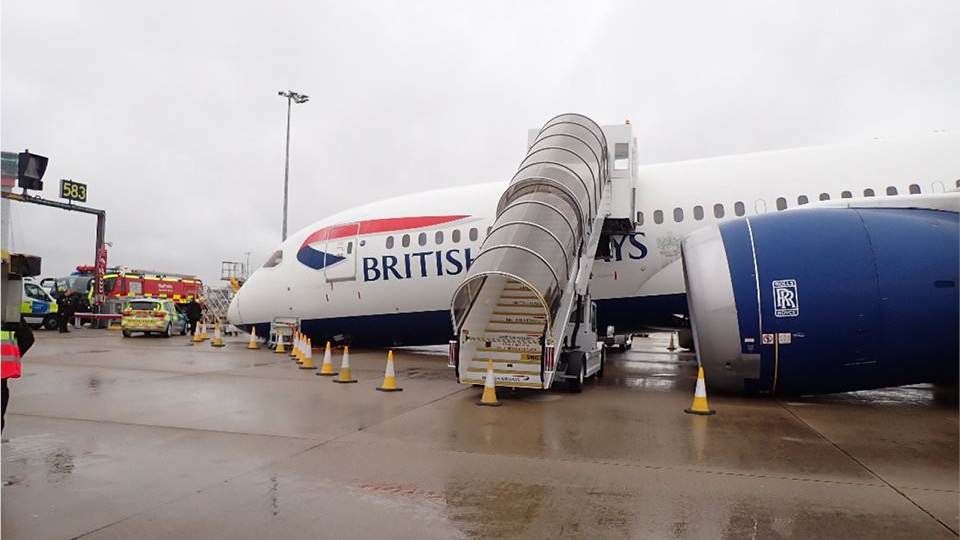 British Airways 787 Dreamliner (G-ZBJB) with collapsed nose landing gear in June 2021 in Heathrow (AAIB / Crown Copyright)
Surveillance video footage from Frankfurt Airport has now appeared that shows the Lufthansa Dreamliner that collapsed on its nose. On the video, it looks indeed like the nose landing gear (NLG) is being retracted, which causes it to collapse.
This occurence is remarkably similar to three other earlier incidents. On 4 March 2016, an Ethiopian Airlines 787 (ET-ASH) collapsed in Addis Ababa after maintenance personnel attempted to cycle the landing gear. In March of 2018, a 787 being operated by Korean Air (N507BJ) ended up on its nose in Grant County International Airport in Washington while undergoing luxury cabin refitting. This was caused by ground personnel wrongly installing what is called a downlock pin. This pin prevents the NLG from retracting if it is cycled while the aircraft is parked on the ground. The Boeing 787 Dreamliner, for some stupid reason, has a second hole right next to the hole where this pin needs to be inserted. If the pin is inserted in the second hole, it apparently feels and sound similar to it being inserted in the correct hole, but it will not prevent the NLG from retracting when it is actuated. The jokes write themselves, really.
NLG actuation on the ground might happen if the pilots or engineers are checking the operation of the hydraulics by activating the gear retraction sequence. For example after receiving errors messages about the landing gear or hydraulic systems from the flight computers. For this reason, the downlock pin needs to always be installed when the aircraft is parked and being worked on.
After the March 2018 Korean Air incident, Boeing issued a service bulletin on 12 March 2019, instructing airlines to install a plug in the misleading hole to prevent the downlock pin from being inserted there. The FAA then mandated this action in an Airworthiness Directive (AD) on 12 December 2019 and gave airlines a three-year deadline to carry it out. On 18 June 2021, a British Airways 787 (G-ZBJB) collapsed in Heathrow. The plane hadn’t had the mandated plug installed yet. And then this happened:
Engineers were trying to clear error messages in the 787’s onboard fault recording system about one of the NLG’s door-closed solenoid valves. Clearing the message involved fitting lock-out pins to the airliner’s undercarriage to prevent it from moving, starting the hydraulic pumps and cycling the gear lever in the cockpit up and down. Without the pins, the landing gear would retract.
Unfortunately for British Airways, a Laurel and Hardy moment resulted in a very expensive blunder when the NLG unexpectedly retracted during the procedure. Two mechanics were sent to fit the downlock pins to the landing gear before confirming to a colleague in the cockpit that the gear was ready.
As Mechanic 1 was not tall enough to reach the NLG locking pin hole without steps, he pointed to the location of the hole and Mechanic 2 fitted the NLG locking pin. Yet Mechanic 2 had fitted the pin to a very similar hole (the NLG downlock apex bore) next to the correct location.
Since D-ABPQ, the Lufthansa plane in Frankfurt, was brand new and delivered only in January, it should have had that plug installed from the factory. Was this plug missing due to an oversight from Boeing that Lufthansa didn’t notice and the maintenance personnel repeated the mistake Ethiopian Airlines, Korean Air and British Airways made before them (despite the AD that has been around for years)? Or did the engineers simply forget to insert the downlock pin at all? Or did it maybe fail? Which I guess is pretty unlikely as it must have been as new as the plane…
The German Federal Bureau of Aircraft Accident Investigation (BFU) is investigating and a preliminary accident report should be released within eight weeks. I will read this with much interest.