
20 Years of Podcasting
They wouldn’t let me on the air when I tried to join the university radio station at Bonn University, so I said “screw this” and in June of 2006, I started my first podcast. It was a podcast about how to keep hamsters. No, I’m serious. It was in German, at a time when basically nobody in Germany had ever heard of this new invention called a “podcast”. Remember, this was before the iPhone. Podcasts back then were usually stored on an iPod (on an actual spinning disk) and synced via iTunes before you left the house in the morning. Needless to say, nobody listened to my first podcast. But I gathered some valuable lessons in how to actually apply the technology to set one up. This was also before one-stop-shop podcast hosting providers. Back then you had to basically run your own WordPress blog with a specialised podcasting plugin and then serve the audio files from your own server.
The first podcast I ever listened to was PowerUser.TV, created by Stardock’s Brad Wardell. The second show I found is actually still going: Security Now with Steve Gibson. This was back in 2005, when I got my first iPod. Through Security Now, I discovered Leo Laporte’s TWiT network and I’ve been a prolific listener of all kinds of podcasts ever since. Incidentally, Leo also got me into social networking, first on Jaiku (a Twitter clone that was trying to improve on the original Twitter design), then on Twitter (now X) — but that is a much longer story for another time.
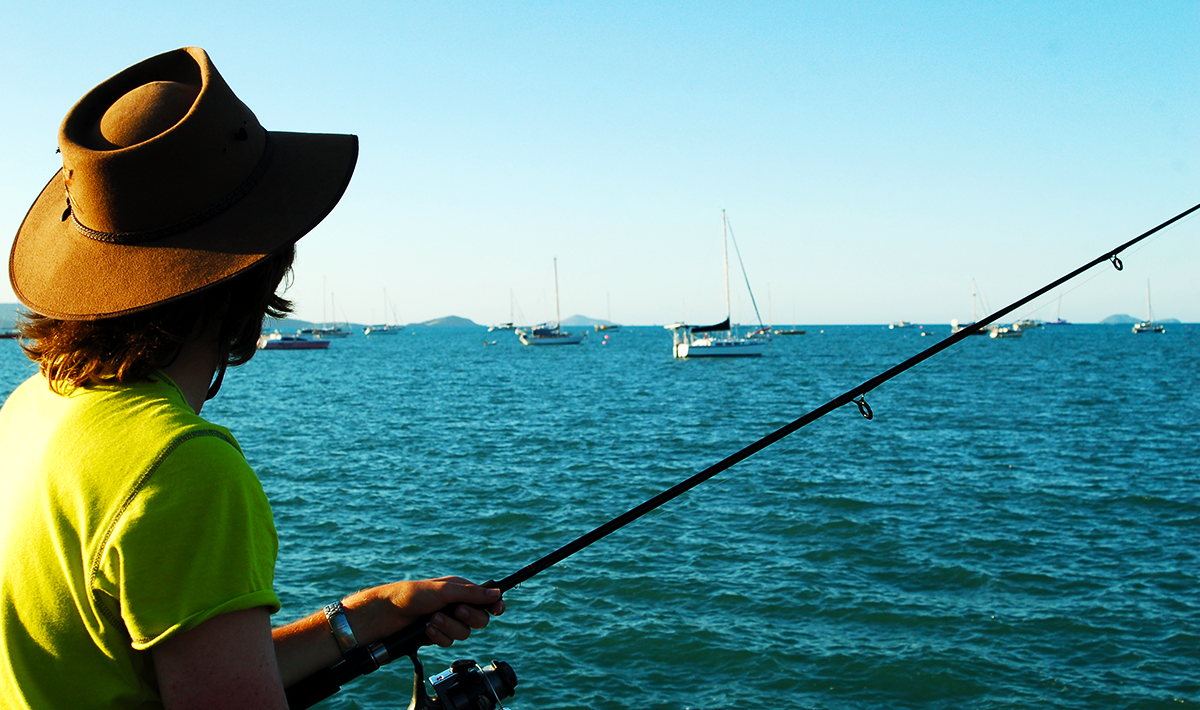 While spending time fishing and wandering around the beautiful nature reserves of central Queensland, Australia in early 2007, I had the idea for what would become “Linux Outlaws”.
During several months living in Australia at the end of 2006 and into the first half of 2007, I spent a lot of time fishing and wandering around beaches and national park trails. I also discovered how much my English had suffered since having spent a year in school in the country in 2000/2001. This is how the idea for a new podcast was born. I had resolved to switch full-time to using Linux on my computers when I got back home to Germany and I wanted to document this journey on a weekly podcast. I resolved to do this podcast in English, partly to have a larger audience and partly because I love the language. An integral part of the plan was to find a native speaker to do the podcast with, which would also help me with speaking English regularly and as such serve to keep my language skills up.
On the aforementioned social network Jaiku, I met Dan Lynch, a fellow Linux user from Liverpool, England and we immediately hit it off with a chemistry that some listeners have, in hindsight, described as “legendary”. Dan and myself created Linux Outlaws, a podcast that ran weekly from 2007 to 2014 for 370 episodes, before we mutually decided to end the show. At its height, Linux Outlaws was the premier Linux community podcast with an immense listenership, for its day.
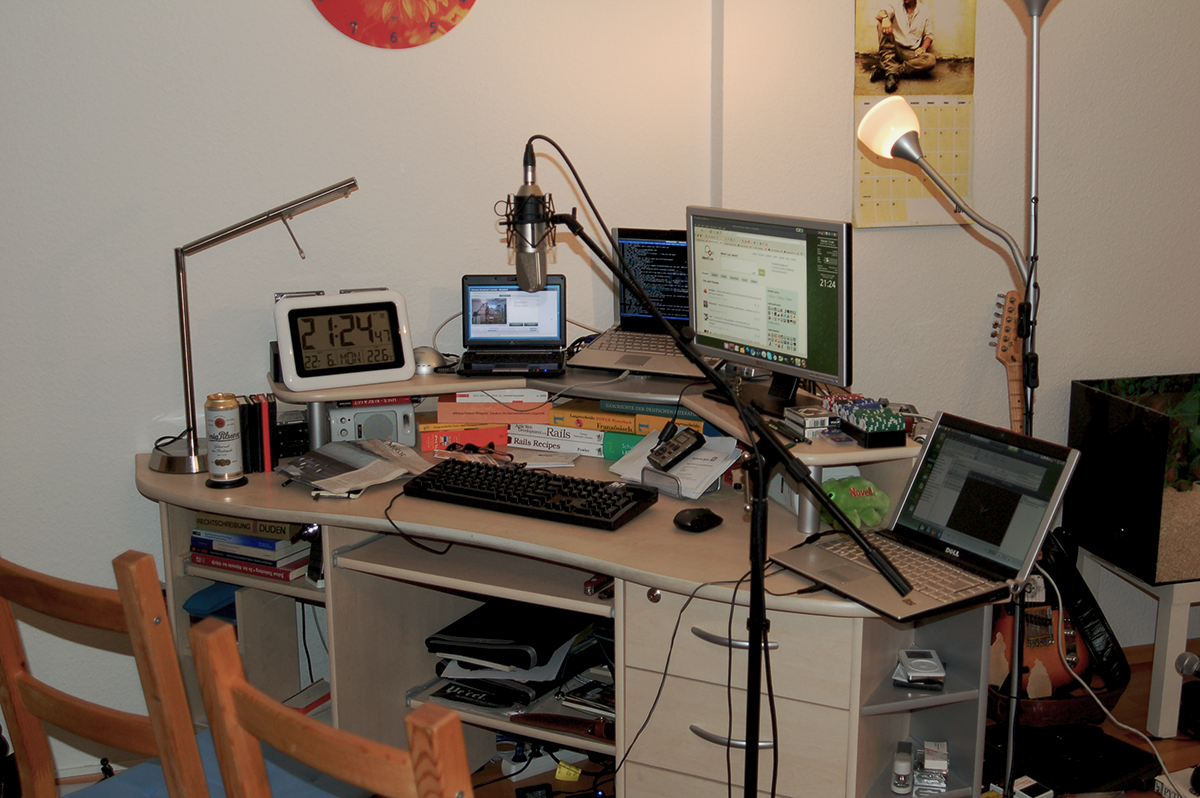 The podcast studio in my flat in Bonn in 2009. At this time, the whole show was entirely produced on Linux. Which, back then, was very hard to do, actually.
The experience of producing, recording and running all of the infrastructure for Linux Outlaws was what got me started on my professional career path as a journalist. It was extremely challenging to produce a fun, but up-to-date weekly news show on such a technical topic. There was a lot of audio editing involved. And on the side, I was running a web server with a CMS, a community forum and the whole distribution mechanism for the podcast. We rolled our own solutions for almost all of that. The podcast first ran on WordPress and was later migrated to Drupal. I also wrote a fully-custom podcasting CMS in Django later, but that never got put into production before we decided to end the show.
I got hired at The H in London pretty much on the knowledge of daily Linux and open source news that I had acquired because of the podcast. The show also allowed me to visit a number of conferences, interview minor Linux and open source celebrities and I made a lot of friends doing all of this, some of whom are still friends even today. Linux Outlaws eventually led Dan and me to create the OggCamp open source conference together with the hosts of the Ubuntu UK Podcast, now called the Ubuntu Podcast. OggCamp actually led to two friends of mine meeting up and eventually getting married — essentially as a consequence of that crazy podcast idea I had back in the beginning of 2007.
I never got paid and I bought all my plane tickets and hotel rooms myself. We also never had advertising on the show. In fact, to this very day, I’ve stayed away from advertising in any of my podcasts. As a consequence, I have been producing free audio content for people, with very little compensation to cover the running costs, for twenty years now.
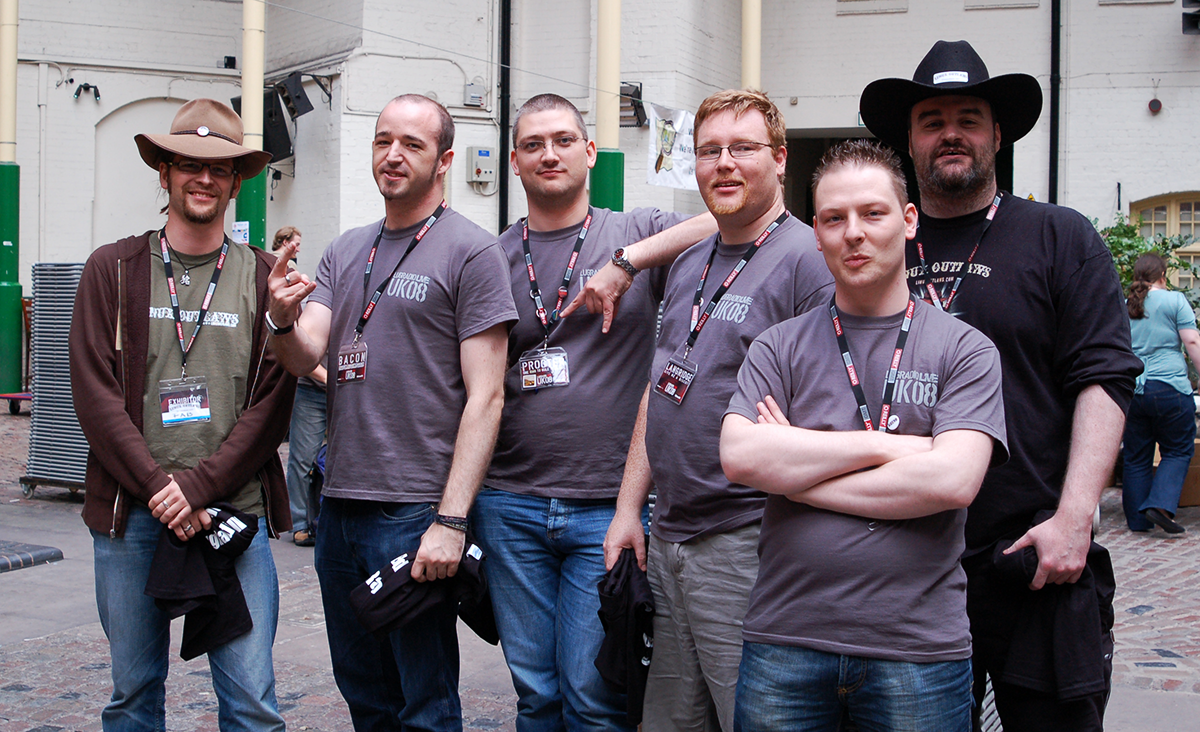 Dan (rightmost) and myself (leftmost) with the boys from “LUG Radio” at the LUG Radio Live 2008 conference in Wolverhampton, England
After Linux Outlaws, I took a hiatus from podcasting that lasted over a year. I had well and truly enough of it. I soon discovered, however, that I can’t live without producing a show on a regular basis. When I started work at Heise in 2013, I was approached by a colleague who’s had the desire to produce an in-house podcast for a while and with a few other colleagues, we created a podcast for the venerable German IT magazine c’t that I named c’t Uplink. The first episode aired on 11 February 2014 and it quickly became one of the most-listened-to tech podcasts in Germany. I was a regular host on the show almost every week until the end of 2018, when I left Heise.
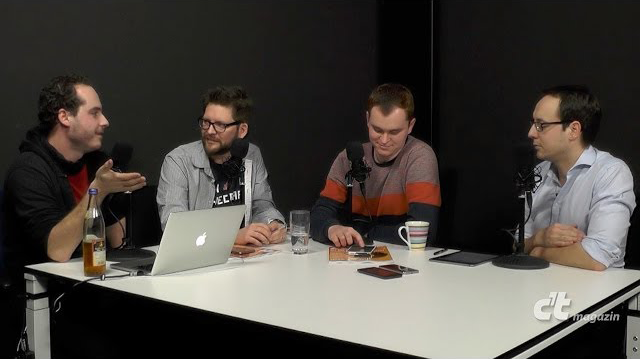 The founding team of “c’t Uplink” during the very first episode: Achim Barczok, myself, Martin Holland and Hannes Czerulla (Screenshot: Heise)
I’ve hosted a number of podcasts since and my current project, Punching Upwards, which I started last year, is going strong and I haven’t missed the scheduled Sunday morning release in 41 weeks.
I love podcasting as much today as I did twenty years ago. In fact, I believe it has gotten more important than ever. People like Joe Rogan have shown how critical this medium has become. This became obvious to me during the pandemic, when podcasts were the only medium free enough to air alternative views that were shunned by the legacy media but later turned out to be right1, and even the mainstream media started understanding it when Rogan interviewed Trump shortly before the election in 2024, providing more insight into Trump’s thought processes and actual personality in three hours than The New York Times, Washington Post and CNN had done in 8 years of coverage of the man.
Because of this growing importance of podcasts as a check on the often atrocious reporting in the legacy media, I am very passionate about the technical aspects of the medium. That is, the original specification for what a podcast is, as established by Dave Winer (the inventor of RSS) and Adam Curry, who created the audio enclosure for RSS that made podcasting possible. This means I see podcasts not simply as “a radio show on the web” or as another nebulous format for content you can stream via Spotify or YouTube, I actually care about having an RSS feed and your own distribution mechanism.
This is very important, because this distribution mechanism via your own domain, possibly your own servers, but most importantly an RSS feed, is what makes podcasts so valuable. If you host your “podcast” on YouTube, Spotify or another big company and hand the means of distribution2 over to them, they can — and will — censor you. This is by no means a theoretical fear. YouTube censored loads of scientifically correct content during the pandemic. Most of it hasn’t been reinstated even today, even after it was vindicated by mainstream opinion. And for a while there, it looked like Spotify would cave to Neil Young’s absurd attempt at silencing Joe Rogan. But if you host your own RSS feed on your own domain, this enables two crucial things:
- No large company or government can censor your content. They can pull it off a server, but you can just move to another hosting provider and point the RSS feed at the new download location.
- No player software can prevent your listeners from getting your content. There are hundreds of podcast players out there and the open RSS standard means that it is trivial for users to switch from one to the other.
For example: I host the audio files for Punching Upwards on Substack. But if Substack were to kick me off for whatever reason, I could just move to another host. As long as you can get to https://fab.industries/podcast.rss, you can get the show.
Podcasting, like running your own website and email under your own domain, are an important — these days almost vital — aspect of making sure we retain at least a small free and independent portion of the internet that is removed from corporate control and the government censorship it engenders. This is the main reason why I keep putting out podcasts every single week. True, I also love doing it, but it is definitely a lot of work. But I do this work because I think it is very important. For the aforementioned reasons.
And this is also why I will, obnoxiously, point out to people that any “podcast” that doesn’t have an RSS feed is no podcast at all. Quirky hosts, outrageous discussions and fun guests isn’t what make a podcast. Sure, having that is better than public broadcasting establishments like The BBC, NPR or the ARD in Germany just putting their radio shows online and calling it a podcast. Which is lame. And boring. But the essence of producing a podcast is still, and always will be, adhering to the podcasting spec. And maybe, if you can, even the 2.0 version of it. So next time someone mentions their podcast, ask them where the RSS feed is at. 😏
I must say that I’ve had the time of my life producing podcasts for the last 20 years. And I will keep doing it as long as I can. And maybe you should think about trying it, too. After all, these days it isn’t hard. Unlike 20 years ago, you don’t need XLR microphones, hardware mixers and complicated audio software anymore. Just as you don’t need to run your own server software. You can even do it easily on Linux now! 😂 And there are USB microphones and one-stop-shop mixing solutions with easy-to-use software as well as all-in-one hosting providers. There is even cheap and easy licensing for music, something we couldn’t even have dreamt of back in the day.
So what are you waiting for? Get podcasting!